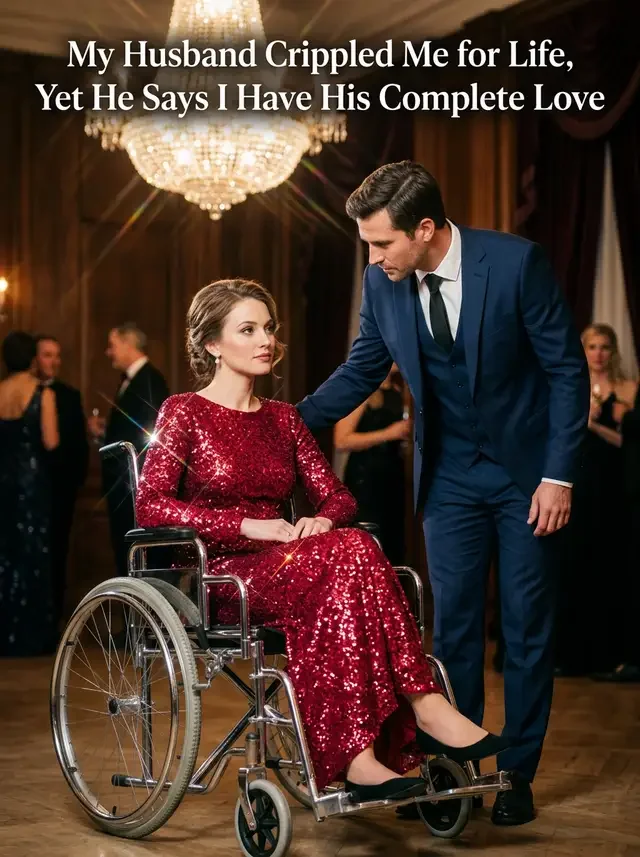
The Polaroid He Burned Wasn't the Last One
Chapter 3
He was standing in the doorway when he said it.
Not inside the room. Just at the threshold, one hand on the frame, his weight leaning in the casual way he had when he wanted to seem like he was just passing by, like the question had occurred to him naturally, like it wasn't something he'd already discussed with someone else before bringing it to me.
"Delia was thinking," Elliot said, "that the color might be a little dark. For a kid's room, I mean. She was wondering if we might want to repaint before Liam moves in."
I was standing at the window with a cup of coffee that had gone cold twenty minutes ago. I didn't turn around right away. I looked at the wall.
Sage green. Not the gray-green that comes out of the can and looks like hospital scrubs in certain light. The real thing — warm, specific, the color of something living. I had spent three weeks looking at swatches before I found it. I'd driven to four different paint stores because I wanted to see it in different kinds of light, morning light and afternoon light and the flat overhead fluorescence of a showroom, to make sure it held.
Elliot had been at the office that Saturday. Or said he was.
I'd come home with the cans and the rollers and the drop cloth and the painter's tape, and I'd done it alone, which I hadn't minded. I'd put on a podcast — one of those long ones, the kind that runs three hours and covers something you'd never think to be interested in, and I'd listened to the whole thing twice through because the first coat went on thin and I had to do it again. I'd climbed the ladder more times than I could count. I'd gotten paint on my forearm and in my hair and on the knee of my jeans, and I'd stood back at the end and looked at what I'd made and felt something I didn't have a clean word for.
Not pride, exactly. Something quieter than that.
Something that had to do with the future.
"Nora."
I turned around.
Elliot's expression was doing the thing again — the reasonable thing, the careful thing. His head tilted slightly, the way it did when he was trying to signal that he understood this was a lot to ask and he appreciated my patience. He had a whole vocabulary of gestures like that. I had spent eight years learning to read them.
"It's just paint," he said.
The room was quiet. Outside, a car passed. I could hear Delia somewhere downstairs, the soft movement of her in my house, the particular rhythm of someone who had already stopped being a guest.
I looked at Elliot. I looked at the wall behind me, that specific, deliberate green, the one I had chosen before anything else in this room, before the furniture or the curtains or the trim, because I had wanted to get the color right first. The color was the foundation. Everything else would come after.
I thought about the Saturday I'd spent on that ladder. I thought about the podcast. I thought about the paint on my knee.
I thought about what I'd been imagining, that day, when I'd stood back and looked at what I'd made.
I turned back to Elliot.
"Yeah," I said. "I'll get the rollers."
His shoulders dropped a fraction of an inch. Relief. The small, private exhale of a man who had braced for something and didn't get it.
"Thank you," he said. "Really, Nora. I know this is—"
"I'll do it tonight," I said. "If I start with the primer now, it'll be dry enough for the first coat by tomorrow."
He nodded. He said something else — something about the paint color Delia had mentioned, something soft and neutral, a yellow maybe, or a warm white — but I had already stopped listening. I was looking at the wall again.
I kept my face very still.
---
I started at nine.
Elliot and Delia were in the living room when I came downstairs for the drop cloth. I could hear them through the hall — the low murmur of the television, her voice asking something, his answering. Domestic. Easy. The sound of two people who had forgotten to be careful.
I went back upstairs without saying anything.
The primer was the flat, chalky kind, the kind that goes on white and dries white and covers everything underneath. I poured it into the tray and loaded the roller and started at the far wall, the one I'd done last that Saturday, the one that had taken the longest because of the corner.
I worked methodically. That was the only way I knew how to do things like this — methodically, without rushing, each section overlapping the last by two inches so there were no gaps. The room smelled like chemical nothing, the blank smell of erasure.
I didn't put on a podcast.
I was on the second wall, the roller moving in slow, even strokes, when my elbow caught the edge of the nightstand.
It wasn't a hard impact. Just enough. The nightstand rocked back against the wall, and the lamp wobbled, and across the room, Elliot's desk shifted slightly on its legs — one of those old, heavy pieces, solid wood, the kind that didn't move easily but moved when they had to. The impact traveled through the floor and the desk's top drawer slid open an inch and a half.
I looked at it.
I set the roller in the tray. I crossed the room and picked up the small flashlight I'd brought up with me — I'd turned off the overhead so the primer would look even in the morning — and I shone it into the gap.
Folded paper. White, medical-weight, the kind that comes from a doctor's office or a hospital. Printed header at the top.
I tilted the flashlight.
Three words.
VASECTOMY CONSENT FORM.
I didn't move.
The light sat on the edge of the paper, just catching the printed letters, and I stood there with the flashlight in my hand and I read those three words again. And then again. Slowly, the way you read something when you need your brain to catch up to what your eyes have already understood.
A vasectomy.
Not a procedure he'd mentioned. Not something he'd brought up in any of the conversations we'd had about our future, about children, about the things we wanted. He had sat across from me at dinner tables and in doctors' waiting rooms and in the car on long drives and he had talked about all of it — the timeline, the hope, the trying — and the whole time there had been a piece of paper in his desk drawer that said something else entirely.
I thought about the consent form I'd signed. Nora Ashford, dark and deliberate.
I thought about Room 411.
I thought about Liam, who had his father's dark eyes and needed a liver and was the reason I had agreed to all of it, every single part of it, because you don't let a child die to protect yourself from something uncomfortable.
I thought about what it meant that Elliot had signed this — whenever he had signed this — and had never said a word.
Downstairs, Delia laughed at something.
And then Elliot's voice, answering.
I listened to the sound of them.
Then I reached out and pushed the drawer closed.
Slowly. Quietly. Until the latch caught and the desk looked exactly as it had before.
I picked up the roller. I went back to the wall.
I kept painting.
You may also like