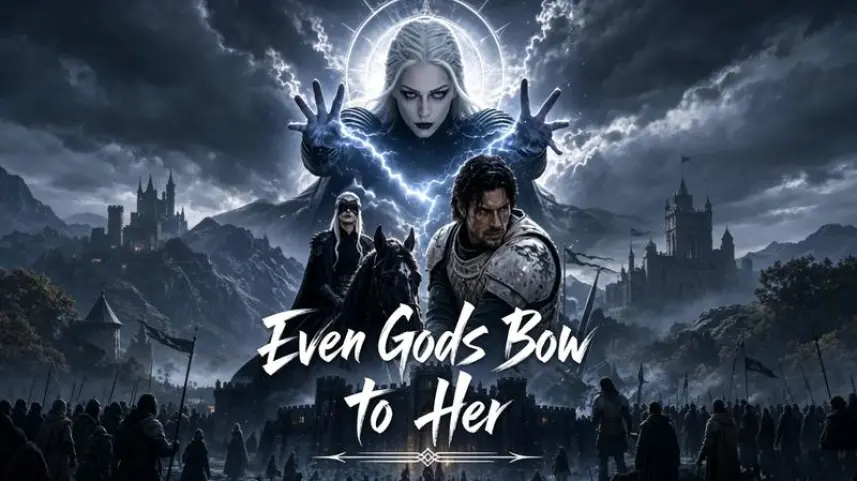
Even Gods Bow to Her: The Goddess Who Gave Everything Away — and Came Back to Take It All

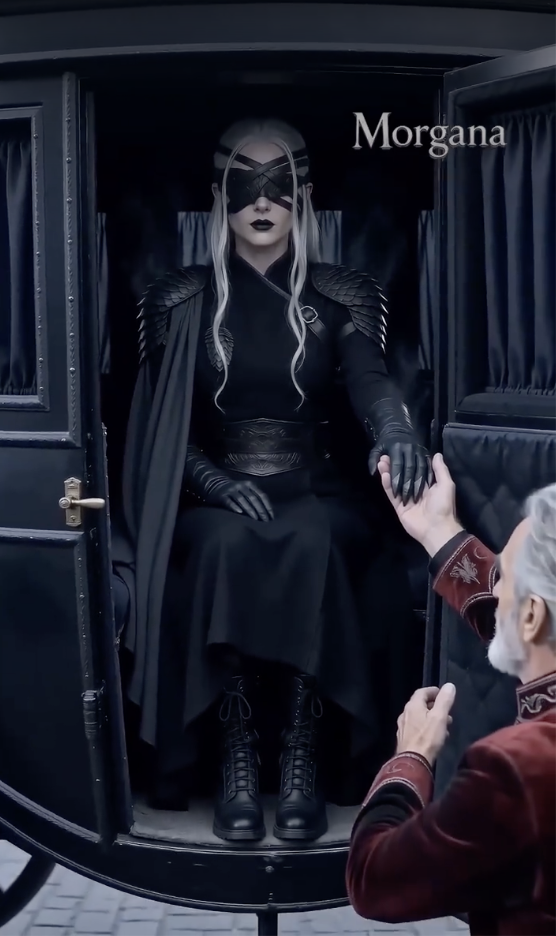
She arrives in a black, crestless carriage. A giant wolf with glowing blue eyes flanks the approach. The sun eclipses at the moment of her arrival. When Morgana steps out — blindfold in place, black veins spreading at her neck — even the lord who runs out in his velvet robes to greet her stops short, his expression shifting from practiced deference to something closer to dread.
Even Gods Bow to Her announces itself in its first scene with the confidence of a drama that knows exactly what kind of story it is — and exactly how much gravity that story deserves.
The Premise and What Makes It Structurally Unusual
Most divine-return narratives are structured as rescue arcs. The god comes back because the world is in danger, the faithful need protection, or some external evil demands a celestial response. The drama positions itself as savior-adjacent and typically delivers a battle between cosmic good and cosmic evil, with the divine figure as weapon.
Even Gods Bow to Her dismantles that template in its premise. Morgana doesn't return because a new threat has emerged. She returns because the threat she already solved — sixty years ago, at the cost of her own divinity — has been quietly replaced by the people she trusted to prevent it. There is no external villain. The betrayal came from inside the sacred covenant she created.
This structural inversion changes everything about how the drama operates. There's no war to fight, no enemy army to face. What Morgana conducts instead is an audit — house by house, bloodline by bloodline, ember by ember. The drama isn't about whether she can win. She is a goddess who shattered her own divinity, distributed it across a continent, and still woke up. The question of whether she can prevail is closed. The question the drama actually asks is: what does she find when she looks?
Morgana: The Wound at the Center of the World
To understand Morgana's character, it helps to sit with what she chose to do sixty years ago. She didn't sacrifice something external — a treasure, a weapon, an army. She tore her own divinity out of herself. Shattered it. Distributed the pieces to twelve bloodlines and then went dormant: eyeless, voiceless, presumed myth.
That act is the drama's emotional baseline, and it is an extraordinary one. Morgana's original sacrifice was total. She gave away what made her a goddess in order to give humanity a future. The trust required to do that — the decision to make herself myth while her power lived in human hands — is not the act of someone who expected to be betrayed. It is the act of someone who genuinely believed.
What she wakes to is the complete destruction of that belief. The twelve houses didn't guard the embers. They weaponized them. Built dynasties. Crowned themselves. Grew wealthy on the power that was meant to stand between humanity and its end. The wound Morgana carries when the drama opens isn't physical — it's the specific grief of someone who gave everything, in good faith, and came back to find it spent on ambition.
That grief is what gives her reclamation tour its cold, particular quality. She isn't angry in the way of someone who has been wronged by a stranger. She's arrived at something past anger — a clarity that has already processed the betrayal and moved directly into consequence.
The Twelve Houses and the Architecture of Betrayal
The twelve bloodlines function collectively as the drama's portrait of institutional corruption — what happens when sacred responsibility is transmitted through inheritance rather than earned through character. The first generation of stewards, who received the embers directly from Morgana, may have understood the weight of what they held. But sixty years is a long time. Power held long enough stops feeling like a loan and starts feeling like a birthright. The embers stopped being a sacred charge and became a dynasty's founding myth — the source of authority, not the condition of responsibility.
What makes this portrait structurally interesting is that the drama doesn't require any single house to be cartoonishly villainous. The corruption it depicts is banal in the way institutional corruption always is: gradual, self-justifying, and entirely invisible to the people inside it. Edmund, the lord who runs out to meet Morgana's carriage, is not presented as a monster. He's a man who inherited something he didn't earn, built a life on it, and is now standing in front of the person it belongs to — watching his expression shift from greeting to shock as he realizes what the visit actually means.
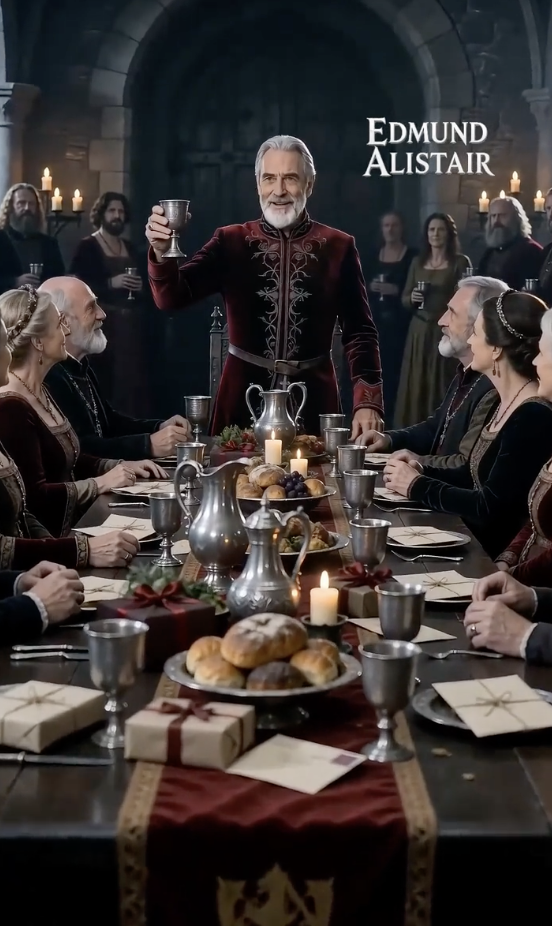
That ordinariness is more damning than villainy would be. Monsters can be defeated. Institutions that simply forgot what they were for — those require something more deliberate.
The Final Truth: What One Question Actually Costs
The drama's most formally distinctive element is the law Morgana enforces on her own terms: each house that surrenders its ember is granted one final question, one final truth, before she takes back what was hers. It's an act of ancient courtesy — a debt she acknowledges even to those who betrayed her covenant.
But the final truth is not a gift. It's a mirror.
Consider what it means to be given one question, knowing it will be answered honestly by an omniscient seer who has just reclaimed the source of your family's power. The question a house chooses reveals everything about what it values, what it fears, and what it has refused to examine across sixty years of accumulating authority. A house that asks about its legacy reveals its vanity. A house that asks about its descendants reveals its guilt. A house that asks nothing — if any dare — reveals something else entirely.
The final truth mechanic transforms what could have been a straightforward power-reclamation plot into something more episodic and more intimate: a series of confrontations where the real drama isn't whether Morgana wins (she does), but what each house's final question tells the audience about the shape of its corruption.
Visual Grammar and the Weight of the Entrance
The drama's visual choices, as confirmed across viewer commentary, are doing serious narrative work. The black, crestless carriage signals immediately that Morgana arrives without allegiance to any house — no crest means no affiliation, no tribute, no acknowledgment of the dynasties that have built themselves on her power. She owes none of them recognition, and the carriage announces this before she steps out.
The wolf with glowing blue eyes is not incidental atmosphere. In the context of a drama about a goddess reclaiming twelve fragments of distributed divinity, a supernatural creature whose eyes suggest supernatural perception is a deliberate extension of Morgana's nature into the physical world around her. The blindfold hides her eyes — but something in her orbit sees.
The eclipse at arrival is the most direct visual statement: the light dims when she comes. Not because she brings darkness, but because her presence reorders the hierarchy of what is significant. For a moment, even the sun defers.
These visual details, stacked at the opening, tell the audience something the plot will spend its runtime confirming: Morgana doesn't arrive as a petitioner. She arrives as the original fact — the thing that was here before the dynasties, and the thing that will remain when they are gone.
The Drama's Real Subject
Strip away the fantasy architecture — the embers, the bloodlines, the seer-goddess with the black carriage — and what Even Gods Bow to Her is fundamentally about is the lifecycle of a sacred trust betrayed by time. The covenant Morgana created was sound. Her original judgment — that humanity needed protecting, that the embers needed stewards, that the bloodlines she chose could bear the responsibility — may even have been correct at the moment she made it. The problem isn't that she was wrong. The problem is that she went dormant.
Institutions require accountability to stay honest. Sacred charges require witnesses. The moment Morgana became myth — the moment the embers stopped being associated with a living, knowing presence and became simply the source of the houses' power — the conditions for betrayal were established. Not by malice, but by the absence of consequence.
Her return is, in this reading, not a revenge story. It's the restoration of accountability to a world that has been running without it for sixty years. Each house gets one truth before she takes back what was hers. That's not punishment. That's a reckoning conducted with the rules she set — which is, in its own way, the most devastating thing she could do. She could simply take. Instead, she makes them answer.
Who This Is For
Even Gods Bow to Her rewards viewers who want their fantasy short drama to carry genuine philosophical weight beneath the visual spectacle. If you're drawn to stories where the protagonist's power is a given and the drama lies entirely in what she finds and what it costs her — and where the confrontations are as much about the truth each house chooses to ask as about the power being reclaimed — this drama offers something rare in the short-form format. It takes its premise seriously. So does Morgana.
recos:




![[Dubbed Version] My Two-faced Boss](https://v.melolo.com/b1265344voduse1318177724/ac13a7675145403705097583385/94EBYl3j6hEA.webp!15491.webp!15491.webp)