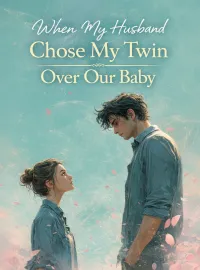
When My Husband Chose My Twin Over Our Baby
Chapter 3
The certification exam had a two-hour time limit. I finished in ninety-four minutes.
I sat at Raelynn's kitchen table with my ginger tea going cold beside me and stared at the results page until the words stopped blurring. Pass. The word was plain and small and entirely undramatic, which was somehow exactly right.
I didn't email anyone. There was no one to email. My mother would have asked what it was for. My father would have said something polite and moved on. Dutton — I closed that door before it opened.
I just sat there in the gray Wednesday morning light, the radiator knocking its usual rhythm, and let the word sit with me. Pass.
Raelynn came home from her shift at four-thirty, still in her scrubs, her hair escaping its braid. She dropped her bag by the door, walked to the kitchen for water, and stopped.
'Is that what I think it is?'
'Illustrator certification,' I said. 'I passed.'
She looked at me for a moment. Then she went to the back of the fridge — past the leftovers, past the condiments — and pulled out a bottle of sparkling cider I had never seen before.
'I've been saving this,' she said, 'for when you did something worth celebrating.'
'Raelynn —'
'Don't.' She was already getting the glasses. 'Just let me do this.'
So I let her. We sat on her couch with our sparkling cider and she made me tell her about every section of the exam, and she listened like it mattered, like I mattered, and for one evening the stone in my chest was a little lighter. Not gone. But lighter.
I almost felt like a person with a future.
---
The email from Hollow Tree Press came on a Friday morning, eleven days later.
I read it twice before I understood what it was. Then I read it a third time, slowly, from the beginning.
The editor's name was Clara Nguyen. Her email was direct and warm and professional, and it said that Hollow Tree Press would like to offer me a freelance illustration contract for an upcoming picture book. A girl who learns to navigate by starlight. She said the manuscript was quiet and brave and that they had been looking for an illustrator whose work matched that register.
Then she wrote: *Your portfolio has a quality of quiet courage that is exactly what this story needs.*
I read that line three times.
Quiet courage. I pressed my thumbnail against my lower lip and stared at those two words. I didn't know if they were true. I didn't know if I was brave or just stubborn, if what I'd been doing these past weeks was courage or just the absence of other options. But Clara Nguyen had looked at the drawings I made in the gray afternoons — the woman in the doorway, the rain on the glass, the fox under the bench — and she had seen something in them worth naming.
I accepted the contract the same day.
---
The art supply store on Canal Street was the kind of place that smelled like turpentine and old wood and had narrow aisles stacked floor to ceiling with things I couldn't afford and a few things I could. I needed illustration-grade pencils and a specific weight of bristol board that Raelynn's neighborhood art store didn't carry.
I took the subway down on a Tuesday afternoon, my tote bag over one shoulder, my coat buttoned against the November cold. The city was doing its usual thing — loud and indifferent and relentless — and I moved through it with my head down, the way I'd learned to move through things that were bigger than me.
I found what I needed. I paid. I stepped back out onto Canal Street.
They were waiting on the sidewalk.
Two men in dark jackets, standing close together, watching the door. I almost walked past them before the taller one stepped directly into my path.
'Meredith.' His voice was flat. Not a question.
I stopped. My tote bag swung against my hip.
'I think you have the wrong —'
'Victor Slade is done waiting.' He said it quietly, which was worse than if he'd shouted it. The other man had moved to my left, not touching me yet, just there. Closing the space. 'You know what you owe. You know what happens now.'
My heart was slamming. I opened my mouth — to say what, I don't know, to explain that I wasn't her, that whatever Meredith had done had nothing to do with me — but the first man's hand closed around my arm, and the words died.
Then a hand closed around my wrist from behind.
Not rough. Firm. And I was pulled sideways, fast, into the narrow gap between buildings — a service alley, dark and smelling of wet concrete — and then a body stepped in front of mine.
Dutton.
He stood between me and the two men with his hands loose at his sides and his posture completely still. He wasn't performing calm. He simply was calm, the way a wall is calm — not because nothing is happening, but because nothing can get through.
He looked at the taller man.
He didn't say anything for a moment. He just looked.
'You have the wrong woman,' he said finally. His voice was level. 'And you're standing in front of me. I'd think carefully about what you do next.'
The two men exchanged a glance. Something passed between them — a calculation, a reassessment. The taller one's jaw shifted.
Then they left. No argument. No threat. They just turned and walked back into the Canal Street crowd and disappeared.
I stood in the alley with my tote bag clutched against my chest and my heart still hammering and stared at Dutton's back.
He turned around.
His eyes moved over me — quick, thorough, the way he looked at things he needed to assess — and something in his expression shifted when he reached my face. Not relief exactly. Something more controlled than that. Something that looked like a man who had been holding his breath for a long time and had just, very carefully, let a small amount of it go.
'Are you hurt?' he said.
'No.' My voice came out steadier than I expected. 'How did you —'
'Are you sure?' He took one step toward me. 'Your arm.'
I looked down. There was a red mark where the man had grabbed me, already fading. 'I'm fine.'
Dutton looked at it for a moment longer than necessary. Then he looked up at me, and his eyes were very dark and very still, and I had the sudden, vertiginous feeling that he had not found me by accident.
That he had never found me by accident.
'Anais,' he said.
Just my name. My real name, in his voice, on a side street in Lower Manhattan, with the city noise pressing in from both ends of the alley.
I didn't answer. I didn't know what to do with the way he said it — like he'd been holding it, like it was something he'd been waiting to put down in the right place.
I pressed my thumbnail against my lower lip and looked at him, and I thought: *I don't know what you know. I don't know what you want. And I am so tired of not knowing.*
But I didn't say any of that.
I just stood there in the alley with my illustration supplies and my secret and my heart, and waited to see what he would do next.
You may also like