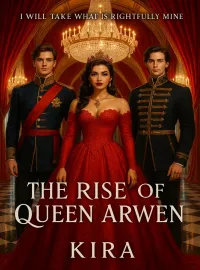
The Rise Of Queen Arwen
Chapter 3
The gates of Valoria rose before them like a dream painted in gold. Spires caught the morning light, banners rippled high above the walls, and the air itself seemed perfumed with rose and salt from the sea beyond. Yet for all its splendour, Arwen felt no awe. Beauty, she had learned, was often a mask — and she had worn one long enough to know its weight.
The procession slowed as they entered the capital. Crowds lined the streets, their cheers rising like the tide. Children scattered petals, merchants craned their necks, and courtiers watched from high balconies with polite curiosity. To them, she was the legend of a fallen kingdom come to life — the child-queen of Ravendale, risen from her own ashes.
Arwen kept her gaze forward, back straight, expression composed. The silver circlet upon her brow was light compared to the burden in her chest. Her handmaidens rode close behind — Faye pale but healing, Mira grim and watchful, Liora silent as ever. Not one of them smiled.
At the foot of the palace steps, a line of guards stood waiting. Their armour gleamed silver and blue, immaculate, unyielding. The air shimmered faintly with heat from the torches burning in their sconces.
Then came the sound of music — soft, ceremonial, but distant enough to seem rehearsed rather than heartfelt.
Queen Aurelia Devienne descended first. Draped in silk the colour of wine, she moved with practiced grace, every step deliberate, every glance measured. Her smile was all sympathy and sorrow, but her eyes — sharp as polished glass — missed nothing.
“My dear Arwen Valehart,” she said, her voice smooth as cream. “How you’ve grown. The last time I saw you, you could barely reach the banquet table.”
Arwen curtsied, the movement flawless though her heart beat hard. “Your Majesty honours me with her welcome.”
“Honour?” Aurelia’s lips curved. “No, child — it is compassion. The gods have been cruel to you. Let us hope they show mercy yet.”
It was kindness wrapped in pity, and pity wrapped in warning. Arwen recognised it at once.
Behind the Queen stood her son — Prince Lucien Duvall.
He was not the boy Arwen remembered. Gone was the shy, soft-spoken child who had given her a seashell in the palace gardens years ago. The man before her stood tall and composed, his dark hair neatly bound, his uniform immaculate. His smile, when it came, was courteous — but it never quite reached his eyes.
“Your Majesty,” he said, bowing. “It’s been a long time.”
“Too long,” Arwen replied, her voice steady though her stomach tightened. “You’ve changed.”
“As have you,” Lucien said, and for a heartbeat his expression softened, revealing something like regret. Then it was gone.
The introductions passed quickly. The court assembled in perfect symmetry — ministers, councillors, generals, all observing her as one might a delicate artefact. Every murmur was calculated, every gesture polite.
They led her through corridors lined with mirrors and marble. Everywhere she looked, gold and glass, but none of it gleamed warm. The palace of Valoria was a masterpiece — and a labyrinth.
At the banquet that evening, the air shimmered with candlelight. Musicians played soft strings, and courtiers whispered behind embroidered fans. Arwen sat at the high table beside Queen Aurelia, Lucien opposite her, King Renard at the head — a stern man with silvered hair and a presence that filled the hall like a storm contained behind glass.
The meal began with toasts and flattery, though Arwen tasted nothing but suspicion. The King’s eyes flickered to her often, cool and assessing.
“So,” he said at last, voice smooth but heavy with intent. “The Queen of Ravendale seeks sanctuary.”
“Not sanctuary,” Arwen corrected softly. “Alliance. As was promised.”
A murmur rippled down the table.
King Renard’s smile did not falter. “Ah, the old arrangement. Times have changed, my dear. Promises made in childhood seldom survive the weight of crowns.”
Lucien’s jaw tightened. “Father—”
Renard raised a hand. “Peace, son. We must speak plainly. Valoria faces delicate negotiations with Britain. The arrival of our young guest complicates those efforts.”
Arwen felt the words land like stones. “You mean my survival endangers your peace.”
The King’s gaze met hers — steady, unflinching. “A harsh way to put it, but yes.”
Aurelia’s hand brushed her wineglass. “Do not mistake prudence for cruelty, child. We only wish to protect what remains of you.”
What remains.
The phrase burned. Arwen’s pulse thundered in her ears, but she kept her voice level. “Then you will not honour the betrothal?”
The silence that followed said more than any answer could.
King Renard lifted his goblet. “Not at present. The world shifts quickly. We must adapt or perish.”
Arwen’s throat tightened. “And what of Ravendale? My people are hunted. My crown stolen. Will Valoria stand idle while a kingdom dies?”
Renard’s smile was faint. “We stand where wisdom demands, not sentiment.”
The music faltered. Even the courtiers seemed uneasy. Arwen rose slowly, her chair scraping against marble.
“Then wisdom must be a cold companion,” she said.
Lucien stood as well, his voice low. “Father, please—”
But the King had already turned away, speaking to his advisors as though she no longer existed.
Arwen bowed her head, every muscle rigid with control. “I thank Your Majesties for your hospitality.”
Aurelia’s eyes softened, though her tone did not. “You should rest, dear heart. Grief makes fools of even the strongest.”
Arwen left the hall without another word.
Her maidens followed in silence through the long corridors, their footsteps echoing faintly. When they reached her chambers, she dismissed them with a quiet nod.
The room was vast and beautiful — gold curtains, carved stone, a balcony overlooking the sea. But beauty had no warmth tonight.
Arwen stood at the window, the moonlight silvering her hair, her reflection a ghost in the glass. The letter she had written — her plea to King Renard — lay unopened on the table beside her untouched wine.
Hours ago, she had believed Valoria to be her salvation. Now she knew better.
She reached for a dagger, tracing the pattern on its hilt. The weight felt right in her hand, familiar, grounding.
Below, the city slept beneath a sheen of silver. Somewhere, music drifted faintly from the palace gardens — laughter, distant and careless.
Arwen whispered into the quiet, “I did not come here to be pitied.”
The words steadied her. She sat before the window, spine straight, eyes hardening with each breath.
In the reflection, she caught a glimpse of herself — not the frightened girl from the convent, nor the grieving child of fallen kings. A shadowed crown rested invisible upon her head.
She thought of Isla, of the blood on her hands, of the fire that had consumed her home.
If Valoria would not stand beside Ravendale, then she would rise without them.
From beyond the window, the palace bells tolled midnight — slow, deliberate, like the heartbeat of fate.
Arwen stood. The decision formed in her chest, solid and cold.
The convent had hidden her. Valoria would not.
She looked once more toward the sea, where the faint glimmer of British ships haunted the horizon. “If they mean to drown my kingdom,” she whispered, “then I’ll teach them to fear the tide.”
Somewhere deep within the palace, a door closed softly — the sound of a new beginning.
And in that silence, Arwen Valehart finally became what she was born to be.
Ravendale’s Queen.
You may also like