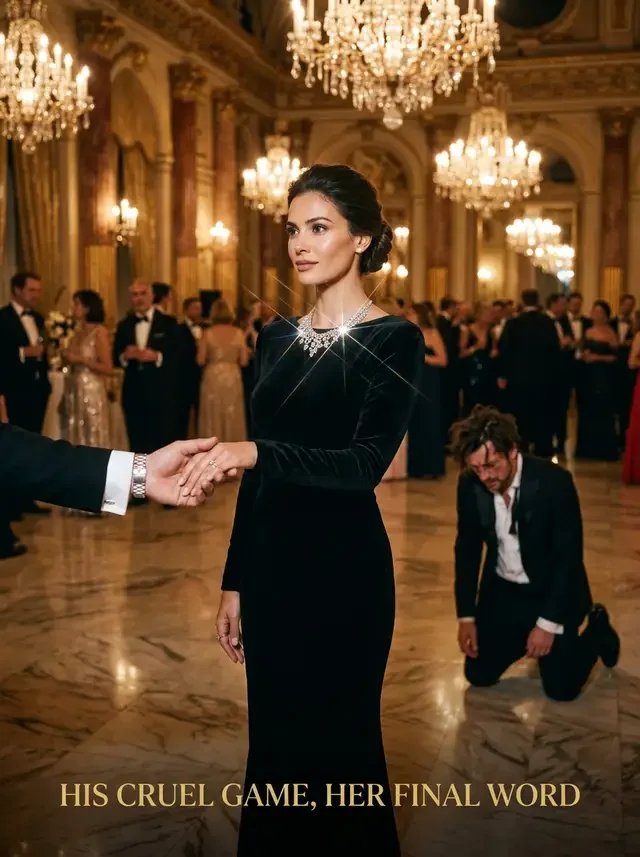
My Husband’s Affair Cost Our Daughter Her Life
Chapter 4
The thing about Serena Voss is that she never knew she was a weapon.
I had known Serena for six years. She was the kind of woman who wore her wealth the way other people wore perfume—present always, never commented upon, impossible to ignore. She and Bianca had circled each other since the first Harvard Alumni Association mixer we'd all attended, two years out of school, back when the stakes felt enormous and were actually nothing. They had the particular chemistry of women who are too similar in ambition and too different in luck. Serena had always come out ahead. Bianca had never forgotten it.
All I needed to do was give Serena's latest acquisition an audience.
The mutual contact was a woman named Priya—cheerful, well-connected, congenitally unable to withhold interesting information. I sat next to her at a charity board meeting on a Monday and mentioned, with the lightness of someone relaying nothing important, that I'd run into Serena recently. That she seemed wonderful. That the Bentley her husband had given her was extraordinary—the color alone. And the Himalayan Birkin, that particular shade, I couldn't even imagine what the waitlist looked like.
Priya was texting before we broke for lunch.
By Friday, Bianca knew.
I knew she knew because she called me that evening and talked for forty minutes about nothing—about the reunion, about what she was wearing, about how she hadn't seen some people in years—and under all of it, running like a current, was a tight, specific energy I recognized. The energy of a woman who has just recalculated.
I listened and made the right noises and kept my voice warm the whole time.
---
The reunion was held in a private room at a midtown hotel. Chandelier light and open bars and the particular performance of people who went to the same school and needed each other to remember it.
Serena arrived forty minutes in. I saw her from across the room—a flicker of navy silk, a bag on her arm the color of clay dust, the casual arrival of someone who has somewhere better to be and is generous enough to stop. Her husband was with her. He touched the small of her back once, briefly, and she smiled at someone she recognized across the room.
I turned and found Bianca.
She was standing near the bar with a glass of white wine she wasn't drinking, her eyes tracking Serena with the particular stillness of someone keeping their face very carefully arranged. I watched her take in the bag. The shoes. The ease of the whole thing.
I moved through the room, stopped to speak to a few people, kept Bianca in my peripheral vision the whole time.
At some point—forty minutes into the evening, maybe fifty—Bianca's phone came out. I was fourteen feet away, speaking to a man I didn't care about, when I saw her type. Quick, decisive. The energy of someone who has made a decision.
I excused myself from the conversation and crossed the room at a pace that had a reason—heading toward the bar, naturally—and as I passed behind Bianca's left shoulder I saw the screen for two seconds.
*you owe me a lot more than dinner*
*birkin. not canvas. leather. you know which one*
*and we're talking about a car*
I kept moving to the bar, ordered a sparkling water, and stood there for a moment with my back to the room. My reflection showed in the mirrored shelving behind the bottles. I looked like someone at a party.
I photographed the screenshots later, in sequence, when Ephraim left his phone on the kitchen counter the following morning and went upstairs to shower. He had agreed to everything. The Birkin. A car. The Maldives. Three separate confirmations, all timestamped within ninety minutes of each other.
I set the phone back exactly where I'd found it and poured his coffee.
---
Ephraim had played golf since college. Not well, but consistently, which meant he had golf friends—men who knew him in the easy, unexamined way of people who only see each other on weekends.
One of them was a man named Todd. Todd was likable and financially undiscriminating and had the valuable habit of treating every new thing someone told him like it was a personal favor he was passing on.
I had planted the name of the platform with Todd through a real estate acquaintance two weeks before the reunion. Just a mention. A friend had done very well, early returns, clean interface, offshore so none of the usual regulatory friction. Todd had done his own research—or what he believed was research—and had already deposited a small amount by the time he brought it up to Ephraim at the driving range on a Saturday morning.
Ephraim didn't tell me. That was expected.
What I watched for were the mornings.
The first week, he woke up slightly early. Came downstairs in the gray pre-light, made his own coffee—he never made his own coffee—and sat with his phone at the kitchen table in a way that looked like reading the news and wasn't. When I came down, he set the phone face-down and asked about my plans for the day. His voice was too neutral. The stillness of someone containing something good.
He had won.
I knew the platform. I knew the architecture of the early sessions—the first three calibrated for exactly this response. Enough return to feel like proof. Enough ease to remove the sense of risk. Just enough winning to make the losses, when they came, feel like an anomaly rather than a structure.
I made breakfast and watched him.
By the fourth morning, something had shifted. The phone was still face-down, but the coffee sat untouched longer. He stared at the window in a way that had direction—a man looking toward something, not just looking. When I asked if he slept okay, he said fine, and smiled, and the smile landed about a half-second late.
He had started losing.
I touched Lily's bracelet once under the table, where he couldn't see.
Outside, the November light was thin and flat, coming through the kitchen window at a low angle that made everything look like it was already over. Biscuit was at my feet. Ephraim's coffee cooled in front of him. He picked up his phone again, set it down, looked at the table.
I refilled his cup without being asked.
'Thank you,' he said.
'Of course,' I said.
I sat down across from him with my own coffee and let the silence do exactly what I needed it to do.
You may also like