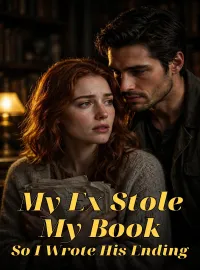
My Ex Stole My Book — So I Wrote His Ending
Chapter 2
The first time I showed Colin a chapter of The Hollow House, he was on the phone with his agent.
"Yeah, yeah, it's coming," he said, waving me off without looking up. "She's typing it now."
She. Not June. Not my wife. She, the typing person in the next room.
I went back to the kitchen table. The radiator clicked. I kept writing.
That was our marriage. I wrote. He took meetings. He took lunches. He took credit in advance, in small installments, the way you take money from a joint account and call it borrowing.
The book took three years because I was also paying our rent. I ghostwrote a celebrity diet book. I ghostwrote a CEO's memoir about leadership, a man who had never led anything except a golf cart. At night, when the paid work was done, I wrote Clara.
Clara was a woman who discovered her husband had built his career on her dead mother's letters. She left him in the middle of the night, with one suitcase and a manuscript in her bag. I thought I was writing fiction. I was writing a rehearsal.
"You're so good at this," Colin said once, reading over my shoulder. "You should let me show it to my editor. Just as a draft. Just to see."
I said yes because I loved him. I said yes because his editor was a real editor, and my manuscript was sitting in a drawer with no name on it but mine. I said yes because a wife is supposed to believe her husband when he says he'll protect her work.
His editor loved it. "This is the one," she told him. "This is your breakout."
Your. Not ours. Not June's. His.
When I asked about the contract, Colin said the publisher wanted a single author name for marketing. "Just for the first book," he said. "We'll fix it on the second. We'll put your name on the next one."
There was no next one. There was a divorce, eighteen months later, after I found the emails from a publicist he was sleeping with, after he told me my jealousy was "bad for his process."
The divorce papers were twenty pages long. On page eleven, in language so boring it was almost invisible, it said Colin would retain the manuscript "as a draft, for further development."
My lawyer said it was standard. My lawyer said a draft wasn't a book. My lawyer didn't know the draft was already finished, already loved by an editor, already on its way to becoming The Hollow House.
I signed because I was tired. I signed because I wanted out of the apartment more than I wanted a fight I couldn't afford. I signed because I believed, stupidly, that he would at least feel guilty enough to leave it in a drawer.
He published it fourteen months later. He thanked me in the acknowledgments. "To J., who believed." One letter. Not even my name.
I learned about the publication from a bookstore window. My opening line, in gold foil, under his name.
That was two years ago. Since then, I had written six books for other people and none for myself. I told myself it was safer that way. A ghost can't be stolen from. A ghost has nothing to lose.
Now Hartwell & Crane wanted a ghost for the sequel. They wanted a pen name. They wanted confidentiality.
I said yes.
I signed the papers under the name J. Marlowe. I told myself it was just a job. I told myself I would write the chapters, take the money, and walk away clean.
The day I signed, a man in a gray suit was waiting outside the publisher's office. He introduced himself as Owen Marshall, the rival publisher's attorney. Not Hartwell & Crane. The other house. The one that had lost the bidding war for Colin's book.
"You don't want to sign that contract," he said, not bothering with hello.
"Excuse me?"
"The sequel contract. It has a trap clause." He smiled, and it was not a kind smile. It was a clever one, the kind that knows it's about to ruin your afternoon. "Clause fourteen. Read it again. Slowly."
"I've read it," I said. "It's standard confidentiality."
"It's not." He leaned against the wall, hands in his pockets, like we were old friends. "It says the ghostwriter owns the words. Not the named author. The ghostwriter. Colin signed it without reading it, because Colin never reads anything he didn't steal."
My pulse kicked. "Why are you telling me this?"
"Because I like watching thieves fall," Owen said. "And because you're June Calloway. I read your divorce filing. I know what he took."
I stared at him. "You investigated me?"
"I investigate everyone who signs a bad contract with Hartwell & Crane. It's a hobby." He pushed off the wall. "Write the sequel, Ms. Calloway. Write it well. And when you're ready to prove whose words those are, call me."
He handed me a card. Owen Marshall, Attorney. No firm name. Just a number, written by hand on the back.
I took the card. I told myself I was only taking it to throw it away later.
I kept it.
I didn't call the number that night. I put the card in my wallet, behind my driver's license, where I would see it every time I paid for coffee. A reminder, not a plan. Not yet.
The next week, I started the sequel. Hartwell & Crane sent me a brief: same voice, same heroine, higher stakes. Clara had to face a bigger enemy. Clara had to lose something she loved. Clara had to win, but not too easily, because readers like to watch a woman suffer before she wins.
I knew Clara's voice because Clara was mine. I could write her in my sleep. The hard part was writing her for Colin. I had to make the chapters good enough that his editor would love them, and dangerous enough that Colin would recognize himself in them.
I set rules for myself. One: no scene that could be traced to a real argument we'd had, word for word. Two: every planted detail had to work as fiction first, so the book would still sell if no one ever noticed the trap. Three: I would not tell anyone what I was doing, not even Owen, until the first chapter was done.
The first rule was the hardest. I kept typing a line, hearing Colin's voice in my head, and deleting it because it was too true. Too true is not fiction. Too true is a lawsuit waiting to happen.
So I changed the details. I moved the kitchen table to a study. I moved the radiator to a fireplace. I kept the feeling. The feeling was the evidence.
At night, after I stopped writing, I went through the old divorce box in my closet. I found the printed drafts. I found the emails where Colin had asked me to "send the new pages." I found a birthday card he'd given me the year the book was finished: "To my favorite writer." He'd written that, in his own hand, and then he'd forgotten he'd written it.
I photographed everything. I saved it in a folder on my laptop, and then I saved it again on a drive I kept in a drawer. I labeled the folder "Proof." Not "Maybe." Not "Someday." Proof.
My friend Dana called that night. She was the only person who knew the whole story, and she'd been there the night I found the bookstore window. When I told her I was taking the job, she was quiet for a second. Then she said, "Okay. But you call me every day. And if he finds out, you call Owen first, then me."
"I will," I said.
"And June?" she said. "Don't fall for the lawyer. He sounds charming, and charming lawyers are the worst kind."
"He's not charming," I said. "He's useful."
Dana laughed. "That's what you said about Colin."
She wasn't wrong. But Colin had been charming and useless. Owen, so far, was the opposite. I intended to keep it that way.
You may also like