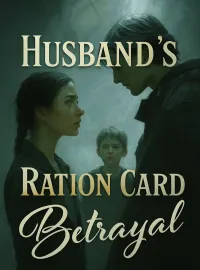
Husband's Ration Card Betrayal
Chapter 2
The pen felt heavy in my hand as I stared at the asset transfer documents. Each word on the page blurred as tears threatened to spill over, but I refused to give them that satisfaction. Devon stood across from me, his expression a mixture of guilt and impatience. Rosalia hovered behind him, her delicate fingers resting possessively on his shoulder.
"Just sign it, Kailani," Devon said, his voice softer than I expected. "It's for the best."
"For whose best?" I asked, though I already knew the answer.
Lane watched from the corner of the room, his young face hardened with a cruelty I'd never thought possible from my own son. "Stop stalling, Mom."
The word 'Mom' from his lips felt like a mockery now. I took a deep breath and signed my name with deliberate strokes, transferring everything I'd worked for—our home, our savings, our future—to Rosalia's name.
"There," I said, sliding the papers across the table. "You've taken everything."
"Not everything," Devon replied, his eyes darting to my scientific credentials that I'd deliberately left out of the transfer. "Those are still yours."
I gathered my research certificates, ID cards, and the few personal belongings I could carry in a single bag. "I'll be gone within the hour."
---
The emergency shelter was a far cry from the home I'd built with Devon. Rows of metal bunk beds filled a warehouse-like space, the air thick with the smell of unwashed bodies and despair. I claimed a narrow cot in the corner, away from the families huddled together in the center.
"First time?" A woman with graying hair asked as she passed by.
"Yes," I admitted, setting my bag down on the thin mattress.
"You'll get used to it," she said with a hollow smile. "Or you won't."
I sat on the edge of the cot, my scientific credentials spread before me like artifacts from another life. How quickly everything could change. Just yesterday I'd been a wife, a mother. Today I was... what? A refugee in my own city?
The shelter's fluorescent lights flickered overhead, casting harsh shadows across the room. Children cried in the distance while adults whispered in hushed tones about ration reductions and rising water levels. I closed my eyes and tried to remember who I'd been before—Kailani Elliott, aerospace researcher, published author, respected scientist.
That person still existed somewhere inside me.
---
"Marcus? It's Kailani."
There was a long pause on the other end of the line before his familiar voice came through. "Kailani? God, it's been years."
"I know," I said, stepping outside the shelter for privacy. "I need information."
"About?"
"The exoplanet exploration program. I heard rumors about emergency transfer slots."
Another pause. "Where are you calling from?"
"A shelter," I admitted. "Things have... changed."
Marcus's voice softened. "I'm sorry to hear that. Yes, there's a program. Three slots for qualified personnel with relevant expertise."
"My research on atmospheric adaptation systems," I said quickly. "I published those papers before..."
"Before you left," he finished for me. "I remember. Your work was groundbreaking."
Hope flickered in my chest for the first time in days. "Can you help me apply?"
---
The application process was rigorous, even under emergency conditions. I spent hours in the shelter's common area, using their outdated computer system to compile my research portfolio. Other residents gave me strange looks as I worked on equations and technical specifications instead of searching for local job opportunities.
"What are you working on?" a young boy asked one evening as I calculated oxygen conversion rates.
"Saving humanity," I replied without looking up.
He laughed, but I didn't join him.
At night, I dreamed of stars and planets beyond our own—worlds untouched by rising seas and betrayal. In these dreams, I was still the scientist I'd once been, still valued for my mind rather than my ability to endure hardship.
---
"The committee has reviewed your application," Dr. Rebecca Walsh said, her voice crisp over the shelter's public phone. "Your work on atmospheric adaptation systems is exactly what we need."
I gripped the receiver tightly, aware of the other residents watching me. "And the slots?"
"Three," she confirmed. "Based on your previous research and publications."
For a moment, I couldn't speak. Three slots meant three chances at life—three opportunities to leave this drowning world behind.
"I'll take them," I said finally.
"There's paperwork to complete," Dr. Walsh continued. "And medical evaluations. But congratulations, Dr. Elliott. You'll be leaving with the next launch window."
As I hung up the phone, I realized I was trembling. Not with fear or uncertainty, but with something I hadn't felt in years—power.
Three slots. Three chances.
And for the first time since Devon had betrayed me, I knew exactly what I was going to do with them.
You may also like