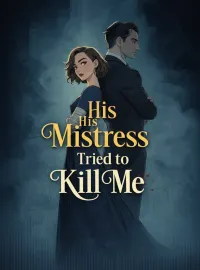
His Mistress Tried to Kill Me
Chapter 2
The canvas screamed in silence. Splashes of cadmium yellow fought against a suffocating cage of charcoal lines, the texture thick and violent where I’d attacked the linen with a palette knife. I called it *The Gilded Canary*, but everyone else just saw abstract chaos.
Marcus Chen stood before it, his arms crossed, the hum of the studio fading as twenty students waited for his verdict. He stepped closer, tilting his head. The silence stretched until it felt like a physical weight on my chest.
"It’s uncomfortable," he said finally. His gaze shifted from the painting to me. "Most students paint what they see. You paint what you fear. This yellow... it isn’t bright. It’s sickly. Desperate."
I gripped my paintbrush, the wood biting into my palm. "It’s just color theory, Professor. Contrast."
"Is it?" He stepped into my personal space, his voice dropping so only I could hear. "Art doesn't lie, Emily. People do. This much pain doesn't come from a textbook. Who locked you in that cage?"
My heart stuttered. I forced a smile, the same practiced mask I’d worn for five years in a Manhattan penthouse. "It’s theoretical, Marcus. Just an exercise in confinement."
He didn't look convinced, but he nodded and moved to the next easel. I exhaled, my breath shaking.
Later, in the storage room, the smell of turpentine and damp canvas overwhelmed me. I slumped against a stack of crates, pressing the heels of my hands into my eyes. Marcus was too perceptive. Leona Fisher was supposed to be dead, rotting at the bottom of the Atlantic, but every time I picked up a brush, she clawed her way out. I was painting my own autopsy, stroke by stroke.
***
The Louvre was a cavern of echoes and shadows, transformed for the gala into something otherworldly. Waiters drifted like ghosts with trays of champagne, the clink of crystal sharp against the low murmur of Paris’s elite. As Marcus’s assistant for the night, I was supposed to be mingling, networking, playing the part of the promising young artist. Instead, I felt like a prey animal sensing a shift in the wind.
I adjusted the silk scarf around my neck—a barrier, a shield—and lifted a tray of flutes.
Then the air in the room changed. It wasn't a sound; it was a gravitational pull. The crowd near the entrance parted, not out of politeness, but out of instinctual deference to power.
He walked in.
Barrett Stone.
Time fractured. The three years of freedom I’d scraped together dissolved instantly. He looked older. The lines around his mouth were deeper, carved by something harder than age. His suit was black, tailored to a lethal precision, hanging on a frame that was gaunter than I remembered. But his eyes were the same—cold, predatory chips of flint scanning the room. He wasn't looking at the art. He was hunting.
My blood turned to ice. Panic, hot and acidic, surged up my throat. I turned sharply, nearly colliding with a patron, the champagne flutes wobbling dangerously.
*Move. Just move.*
I kept my head down, weaving through the bodies, desperate for the exit. But the crowd was a wall of tuxedos and designer gowns, impenetrable. Barrett was moving toward the center of the room. If I went for the main doors, I’d cross his line of sight.
I veered left, toward the discreet hallway leading to the restrooms. My legs felt heavy, like I was back in the ocean, the lead weights dragging me down. I pushed through the heavy door of the women’s restroom and collapsed against the marble sink, gasping for air.
The room was empty, silent save for the drip of a faucet. I splashed freezing water on my face, staring at my reflection. My hair was different—shorter, dyed a dark chestnut—but the eyes were still Leona’s. Terrified. trapped.
The lock on the main door clicked.
The sound was a gunshot in the quiet. I froze, water dripping from my chin.
The door opened, and Barrett stepped inside. He didn't look around. He didn't check the stalls. He looked directly at me in the mirror.
He turned and locked the deadbolt behind him.
"You're in the wrong room," I said. My voice was Emily’s—accented, pitched lower. A stranger's voice.
Barrett didn't speak. He walked toward me, his steps slow, deliberate. The space between us shrank, consumed by his presence. He stopped inches behind me, his reflection towering over mine. I could feel the heat radiating from his body, a familiar, suffocating warmth.
He leaned in, his nose brushing the hair behind my ear. He inhaled deeply, a shudder running through him.
"Vanilla and sandalwood," he whispered, his voice a ragged edge against my skin. "You always wore it when you wanted me to think you were happy."
I spun around, my back hitting the cold marble counter. "Monsieur, please. I don't know who you think I am, but—"
He slammed his hands on either side of the sink, boxing me in. The violence of the movement made me flinch, my body betraying me before my mind could catch up. His eyes bored into mine, searching, dissecting.
"Don't," he growled. "Don't insult me with that accent."
"My name is Emily," I insisted, though my voice trembled. "I'm a student. Let me go."
Barrett’s expression didn't change. He reached out, his fingers hovering over my hip bone, just above the fabric of my dress. He didn't touch me, but the memory of his touch seared through the silk.
"Small birthmark," he recited, his voice devoid of emotion, terrifyingly factual. "Shaped like a teardrop. Right here. And a scar on your left knee from when you fell off your bike at seven. You told me that story the first night I brought you home."
The air left my lungs. The lie crumbled. There was no Emily. There was only the girl who had sold her soul in the rain.
He leaned closer, his eyes dark with a mixture of madness and relief. "Hello, Leona."
You may also like