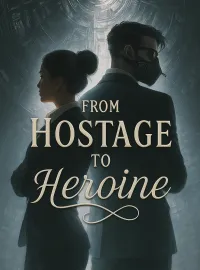
From Hostage to Heroine
Chapter 2
Consciousness returned in fragments. First, the absence of pain—or rather, its muted presence beneath something pharmaceutical and kind. Then softness, sheets with a thread count I couldn't begin to guess. Finally, light filtering through curtains that weren't mine, painting unfamiliar walls in shades of cream and gold.
I tried to sit up. My shoulder protested with a dull ache that made me gasp, and immediately a presence materialized beside the bed. Him. The masked man from the warehouse, though in daylight the mask seemed less threatening—smooth and neutral, revealing only his eyes and the strong line of his jaw.
"Easy," he said, and that voice again sent recognition skittering through my consciousness like a dream I couldn't catch. "Your shoulder was dislocated. The doctor reset it, but you need to stay still."
Doctor. I looked down at myself, finding my arm properly bandaged, my wrist splinted with professional precision. Someone had dressed me in silk pajamas that definitely weren't mine. The realization made my face burn.
"Who are you?" My voice came out scratchy, unused.
He adjusted the pillows behind me with surprising gentleness. "Someone who couldn't watch you suffer any longer." A non-answer, delivered with finality that suggested the topic was closed. "Are you hungry? The kitchen prepared soup."
The days blurred together after that. He came and went like clockwork—bringing meals on trays, adjusting my pillows, sitting in the chair beside my bed with a book or his phone while I drifted in and out of sleep. He never removed the mask. Never offered his name. But his hands were steady when he helped me sip water, and he remembered without asking that I preferred chamomile tea.
Chamomile tea. The brand was familiar in a way that made my chest tight. I'd drunk this exact variety as a child, in a kitchen that smelled like vanilla and safety.
"Why are you doing this?" I asked one afternoon, when the silence had stretched too long.
He set down his book, those visible eyes studying me with unsettling intensity. "Because you deserve to be cared for. Because someone should have done this months ago." A pause. "Because I couldn't stand by anymore."
The words settled over me, heavy with implications I was too tired to unpack.
By the fourth day, I could walk to the window. The garden below bloomed with flowers I recognized—the same varieties that had grown between houses in my old neighborhood. Coincidence, surely. Everything felt like coincidence when your world had shattered.
I was standing there, tracing invisible patterns on the glass, when voices drifted up from below. Feminine. Laughing. My stomach dropped before my brain caught up.
Deacon appeared in the doorway, tension radiating from his frame. "You should rest. I'll handle—"
"Whitney!" Marie's voice rang out, saccharine and sharp. "We heard you were recovering here. We simply had to visit."
I turned to find them in the garden, looking up at my window like predators who'd located prey. They wore matching sundresses, their makeup flawless, their smiles identical and cruel.
Something hardened in my chest. "Let them up," I said quietly.
Deacon's jaw tightened behind the mask. "You don't have to—"
"Let them up." I needed to face this. Needed to prove to myself I could.
They found me in the garden twenty minutes later, after I'd dressed myself with shaking hands and descended the stairs on legs that trembled. The outdoor air felt like exposure, but I lifted my chin and met their identical gazes.
"Oh, Whitney." Marie drifted forward, her fingers trailing across the flowers—the same ones I'd noticed from my window. "You look so pale. Though I suppose that's to be expected after such an ordeal."
"We felt terrible about what happened," Audrey added, her voice dripping false sympathy. "Logan was beside himself with worry. About us, of course. The whole experience was so traumatic."
Marie laughed, light and poisonous. "He bought us matching bracelets to help us feel safe again. Isn't that sweet? He had them specially designed." She extended her wrist, where platinum and diamonds caught the sunlight. "He said he wanted us to always feel protected."
The gesture was deliberate, positioned exactly where I could see the craftsmanship—so unlike the handmade bracelet I'd given him. The one he'd discarded.
"He has such a generous heart," Audrey continued, moving to stand beside her sister in perfect synchronization. "Just yesterday he was telling us about this private joke we share. You know the one, Marie? About the coffee order?"
"Oh yes." Marie's smile sharpened. "The caramel macchiato incident. He calls me his 'sweet disaster' now. It's silly, but adorable."
They watched me, waiting for my face to crumble. Waiting for tears or rage or any sign their words had landed. And they had—each revelation a small knife between my ribs. Logan had pet names for them. Inside jokes. He bought them jewelry with thought and care.
He'd given them everything I'd begged for in silence.
"You must understand, Whitney," Audrey said gently, adjusting an imaginary wrinkle in her dress. "Some women simply know how to hold a man's interest. It's not your fault you couldn't. Logan needs someone who can match his energy, his ambition. Someone who excites him."
"We didn't mean to take him from you," Marie added, touching the flowers again with possessive familiarity. "It just happened so naturally. He said he'd never felt this way before—about anyone."
The word 'anyone' hung in the air, erasing me from Logan's history with casual brutality.
They left eventually, their mission accomplished, their departure marked by satisfied glances and synchronized waves. I stood in the garden long after they'd gone, my good hand gripping the back of a chair, my breathing shallow.
I made it to my room before the dam broke. The sobs came from somewhere deep and primal, shaking my entire frame. I pressed my hand against my mouth, trying to muffle the sounds, but they escaped anyway—ugly and raw and utterly beyond my control.
The door opened. I didn't turn, couldn't bear to be seen like this, but then arms wrapped around me from behind, strong and careful of my injuries. He held me as I shattered, one hand cradling the back of my head, the other steady against my waist.
"I'm sorry," he murmured into my hair. "I'm so sorry you had to hear that."
The mask was gone. I could feel the warmth of his breath against my temple, the rough texture of his jaw brushing my forehead. But my vision was too blurred with tears to see his face, and some part of me was grateful—this moment felt too vulnerable for revelation.
I turned into his chest, soaking his shirt with tears I'd held back for months. He simply held me, murmuring words I couldn't quite hear but felt in my bones—comfort and fury and a promise that sounded like protection.
When I finally quieted, exhausted and empty, his hand traced gentle patterns on my back. The gesture was achingly familiar, like something from a dream I'd forgotten upon waking.
"You're not alone," he said softly. "Not anymore."
I wanted to believe him. Desperately. But belief felt dangerous when safety had proven so unreliable. Still, I let myself lean against him, let myself accept this moment of shelter, even as guilt whispered that I shouldn't find comfort in a stranger's arms so soon after my world had collapsed.
Even as something deeper whispered that he wasn't a stranger at all.
You may also like