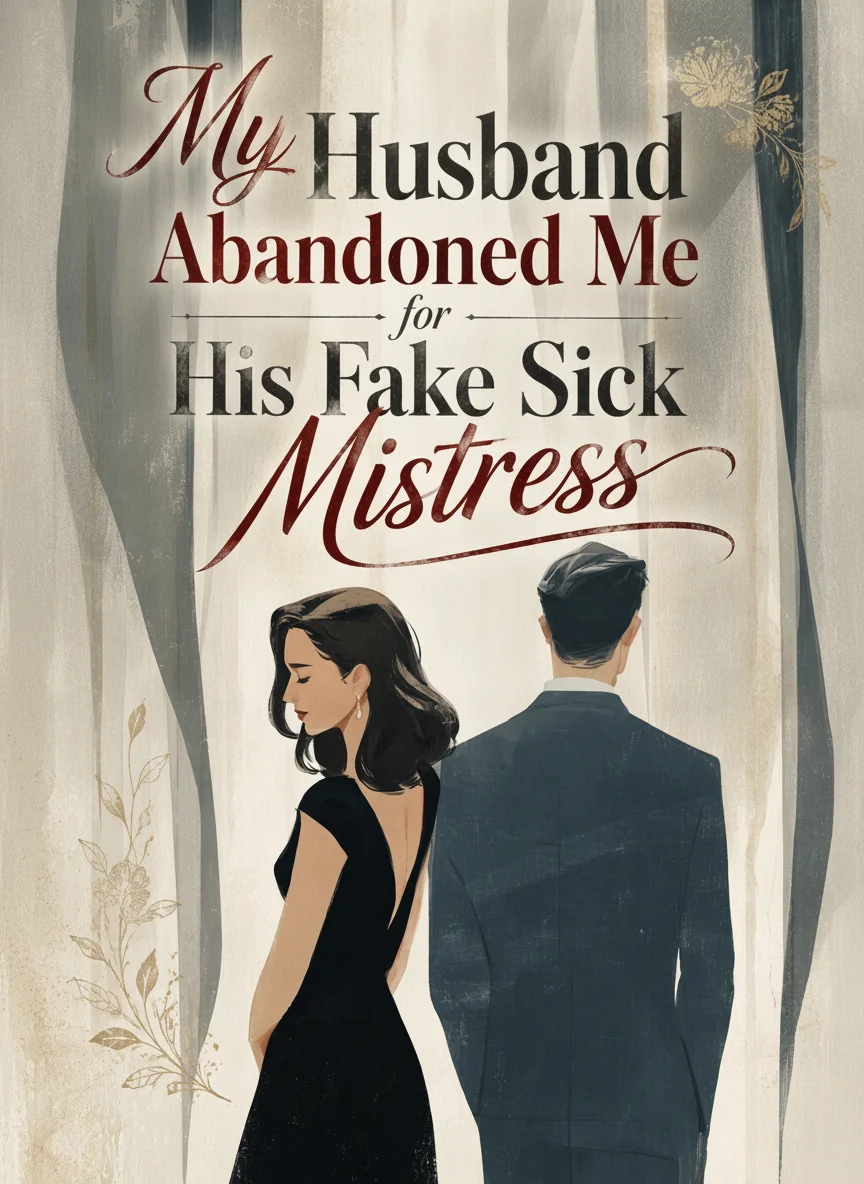
After My Fiancé Proposed to His Mistress on Stage
Chapter 1
The rooftop smelled like champagne and money.
Fifty floors above Midtown Manhattan, Elias Williamson's thirtieth birthday gala stretched across the open air like something out of a magazine spread. Champagne towers caught the light. String quartets competed with the skyline. Every person up here had a net worth with at least seven zeros, and every single one of them was watching me.
They always watched me at these things. Nina Reed, the fiancée. Patient, polished, permanent.
I stood near the east railing with a champagne flute I hadn't touched, looking out at the city below. The October wind off the Hudson was cold enough to sting, but I hadn't moved inside. I liked the sting. It kept me sharp.
Elias was working the room the way he always did — laughing too loud, touching shoulders, making everyone feel briefly chosen. He was magnetic. I knew that before I loved him, and I'd never stopped knowing it even when loving him started to feel like holding something with both hands that kept cutting me anyway.
Six years.
I heard the microphone feedback before I turned around.
Elias stood at the center of the rooftop, one hand curled around a mic the DJ had surrendered, the other raising his glass. The quartet went quiet. The crowd shifted. He was smiling the way he smiled when he wanted an audience — wide, easy, a little dangerous.
"I want to share something," he said. "Since everyone important to me is here."
I turned fully.
He found me in the crowd first. His eyes locked on mine for just a beat — checking, the way he always did, that I was watching — and then he looked away.
"I've decided," he said, voice carrying clean and clear across the rooftop, "that I'm going to marry Serena Cole."
The name landed in the room like a stone into still water. Ripples went out in every direction.
Serena Cole. The model he'd been photographed with for the past three weeks. The woman he'd paraded through two industry dinners while I sat across conference tables from his father's attorneys, reviewing our joint asset clauses.
Every head on that rooftop turned toward me.
I felt it — fifty pairs of eyes calibrating, waiting. Waiting for my chin to tremble. Waiting for the glass to slip. Waiting for Nina Reed to finally, publicly, crack.
Something happened instead.
Something went quiet.
Not numb. Not frozen. Quiet — the way a room goes quiet after a door shuts for the last time. Deep and final and oddly clean.
I looked at Elias. He was still smiling, but the smile had shifted. It was searching now. Reaching for the reaction he'd engineered this entire evening to produce.
I didn't give it to him.
I lifted my champagne glass.
I walked toward the center of the room slowly, heels steady on the stone terrace, and the crowd parted the way crowds do when they sense something is happening that they'll be describing for years. I stopped about ten feet from him. Close enough to be seen. Far enough to be free.
"Congratulations, Elias." My voice came out level. Warm, even. "And to Serena — I mean this — I hope she's everything you deserve."
I took one sip of the champagne.
Then I set the glass down on the nearest table, picked up my clutch from the back of a chair, and walked to the elevator.
No tears. No trembling. No scene.
The doors closed behind me, and I watched Elias through the narrowing gap. The smile was gone. In its place was something I had never seen on his face before — something unraveling.
I looked away before the doors met.
---
The lobby of the Baccarat Hotel was cool and marble-quiet after the rooftop chaos. My driver had the car at the curb before I reached the door. I got in, gave him my address, and sat back.
My hands were steady. That surprised me a little.
The city moved past the windows — yellow cabs, lit storefronts, the particular blur of Manhattan on a Friday night — and I let myself sit inside the silence and take inventory. Six years. An engagement ring I'd stopped wearing to sleep eighteen months ago because I told myself it was uncomfortable. A joint appearance at the Reed–Williamson investor summit three weeks from now that I would now be attending alone.
Alone.
The word settled without the weight I'd expected.
My phone started going off before we hit Fifty-Seventh Street.
Three texts from board members. Two missed calls I didn't recognize, which meant fund managers who had gotten my number from people they shouldn't have. And then my CFO, Marcus Webb, whose messages were never more than ten words:
*We have 48 hours before Hargrove Capital signals exit.*
I read it twice.
There it was. The real crisis. Not the humiliation — I would survive humiliation. I had survived six years of smaller versions of tonight. The crisis was the seventeen percent of Reed Industries' operating capital currently tied to the Williamson alliance structure, and the three institutional investors who had backed our last development round specifically because Carter Williamson's name was attached to ours.
Without that name, we were exposed. Forty-eight hours before the vultures started circling.
I looked out the window.
The penthouse was quiet when I got home. I didn't turn on many lights — just the kitchen, just enough. I poured two fingers of bourbon I didn't need and stood at the window that looked south, toward the financial district, and thought.
I did not think about Elias.
I thought about the board. I thought about Hargrove. I thought about who in this city had enough capital, enough reputation, and enough interest in a Reed alliance to move in forty-eight hours.
The list was short.
At the bottom of it, one name.
I picked up my phone. Opened my contacts. Scrolled past family, past my attorney, past advisors whose advice I already knew, until my thumb stopped.
*Landon Black.*
I stared at it for four seconds.
Landon Black — CEO of Black Enterprises, my most consistent competitor in three market verticals, and the one person in the Manhattan business world who had never, not once, underestimated me. I knew his reputation the way you know a rival's face: every angle, every reported move, every deal that had quietly ended someone else's quarter. Controlled. Precise. Allergic to sentiment and terrifyingly effective.
We had never had dinner. We had never had a real conversation that wasn't about competing interests on opposite sides of a table. What we'd had were seven years of watching each other from across rooms and knowing, without saying it, that the other person was the one worth watching.
I pressed call.
He answered on the second ring.
"Black."
Just his name. Like he had time for nothing else, which he probably didn't.
"It's Nina Reed," I said. "I need a private meeting. Your office. Tonight, an hour from now."
A pause. Brief and unreadable.
"I'll be there."
He hung up before I could.
I set the phone down on the counter and looked at the bourbon glass I hadn't touched.
Neither of us had mentioned the gala. But I had no doubt — none — that he'd already seen the clip. Manhattan's social media was nothing if not efficient.
I left the bourbon where it was. I had work to do.
You may also like