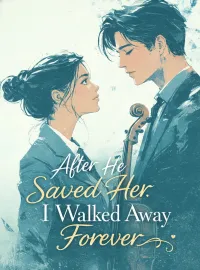
After He Saved Her, I Walked Away Forever
Chapter 3
The pastries were in a small brown paper bag, folded neatly at the top, sitting in the center of my desk like they had always been there.
I set down my coffee and looked at them. Almond croissant. The kind from the French place on Mercer, not the campus café. The campus café didn't carry them. I knew because I had checked, once, in the first week after I moved to Seattle, when I was still learning which small comforts were available to me in this new version of my life.
There was no note.
I went to the department office and asked Sandra if anyone had come by before eight.
She looked up from her monitor. "Not that I saw. I got in at eight-fifteen. Door was already unlocked."
I thanked her and went back to my desk.
I sat down. I looked at the bag. I thought about who arrived at the music building before I did. I arrived at seven-fifty, which was earlier than any of my colleagues and earlier than most students. I had never seen anyone in the corridor when I came in. Except, occasionally, a light already on in one of the practice rooms at the far end of the hall.
I ate the croissant. It was still slightly warm.
I said nothing.
The next morning, I stopped at the French place on Mercer on my way in. I ordered a black coffee — no sugar, no milk, the way I had heard him order it in the campus café on three separate Tuesdays. I walked to the music building, went to my office, set down my bag, and then walked back down the corridor to the practice room at the far end.
The light was on. I could hear him inside, running scales. Careful, methodical, the same passage repeated until the fingering was clean.
I set the coffee on the bench outside the door.
I walked back to my office and started on my lecture notes.
Neither of us mentioned it. Not that day, not the next. But the bag appeared again on Thursday. And the coffee appeared again on Friday. And somewhere in the space of two weeks, without a single word exchanged about it, it became a thing we did.
I told myself it was nothing. A small courtesy between two people who kept early hours. The kind of thing that meant nothing beyond itself.
I was getting worse at lying to myself.
---
It was a Wednesday evening when I heard it.
I was staying late to finish marking a set of counterpoint exercises, the kind of work that required quiet and a red pen and a willingness to be disappointed. The building had emptied out. The corridor lights had gone to their dim after-hours setting. I had my office door open because I liked the silence of the building at night — the way it felt like the music had just left the room and might come back.
Then it did.
Not scales. Not an exercise. The opening bars of "Because of You," drifting down the corridor from the practice room at the far end.
I stopped writing.
The sound reached me the way cold water reaches you — all at once, everywhere. I knew that violin. Not the piece, not the key, not the tempo. The instrument itself. The specific resonance of it, slightly warm in the upper register, with a particular depth on the G string that I had never heard in any other instrument. My father had chosen it for me when I was twelve. I had played it for fourteen years. I would know it in a room full of violins, in the dark, with my eyes closed.
I was on my feet before I decided to stand.
I walked down the corridor. The practice room door was closed. The small window in the door showed Dante inside, standing with his back half-turned, the violin tucked under his chin. My violin. He played the opening phrase slowly, with the careful correctness I had come to recognize — not the fluency of someone born to it, but the precision of someone who had worked very hard to get here.
I stood in the hallway and I listened.
My left thumb found the inside of my right wrist. I pressed it there, against the ridge of scar tissue, the way I always did. Checking. Making sure.
The damage was still real. But something else was real too, now. Something I hadn't felt in a year. Not pain, exactly. Not grief. Something more like — presence. The presence of music in a place where there had only been its absence. Like a room that has been dark for a long time, and someone has opened a window.
I stood there until he finished the phrase. Then I stood there a little longer.
Then I knocked.
---
He opened the door and looked at me without surprise. As if he had known I was there. Maybe he had.
"That's my violin," I said.
It wasn't a question. I wasn't sure what it was.
He looked down at the instrument in his hand. Then back at me. "A woman gave it to me," he said. "Outside a chapel in London. About a year ago." His voice was even. Unhurried. "I've kept it because it's the most important thing anyone has ever trusted me with."
The corridor was very quiet. The dim lights made everything feel slightly outside of time.
He didn't say he knew it was me. He didn't need to. The recognition moved between us like a current — quiet, complete, requiring nothing.
"Why here?" I asked. My voice came out steadier than I expected. "Why bring it to Weston? Why play it in this building?"
He considered the question. Not performing consideration — actually thinking about it, the way he thought about everything, with a patience that had no performance in it.
"Because this is where the music belongs," he said.
I looked at him. I looked at my violin in his hands — held carefully, held with the particular attention of someone who understood what they were holding. I thought about the paper bags on my desk. The coffee on the bench. The Tuesday mornings in the café. The rain and the Shostakovich argument and the laugh that had come out of me before I could stop it.
I thought about a young man on a low wall outside a chapel, playing with his eyes half-closed, meaning something even when the technique wasn't quite there.
I didn't answer him. I didn't have an answer that felt honest yet, and I had made a rule for myself, after London, about saying things I didn't mean.
I turned and walked back down the corridor to my office.
I did not pull back. I noticed that. I noticed it the way you notice a change in weather — not dramatic, not sudden, but real. Something had shifted. Something small and structural, like a door that has been closed for a long time, opening just enough to let in air.
I sat down at my desk. The counterpoint exercises were still spread in front of me, waiting.
I picked up my red pen.
Down the corridor, after a moment, I heard him begin to play again.
You may also like