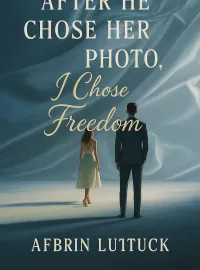
After He Chose Her Photo, I Chose Freedom
Chapter 3
I don't remember much after collapsing in the parking garage. Fragments float through my memory: a stranger's concerned face hovering above me, the wail of an ambulance, the harsh fluorescent lights of an emergency room ceiling sliding past as I was wheeled down a corridor.
When I fully regained consciousness, I was lying in a hospital bed, an IV drip connected to my arm and the steady beep of a heart monitor providing a mechanical soundtrack to my thoughts.
"Mrs. Blackwood?" A woman in a white coat approached my bedside, clipboard in hand. "I'm Dr. Patel. How are you feeling?"
"Tired," I whispered, my throat dry. "What happened?"
"You collapsed from extreme fatigue and anemia," she said, her voice gentle but concerned. "Your hemoglobin levels are dangerously low. Have you been experiencing dizziness? Shortness of breath? Unusual fatigue?"
I nodded slowly, recalling how I'd been needing to sit down after climbing the stairs to our apartment, how even the simplest tasks had left me winded for months. "I thought I was just... stressed."
Dr. Patel's eyebrows drew together. "This isn't something that developed overnight, Mrs. Blackwood. You've likely been anemic for quite some time. Has no one noticed the symptoms? Your husband, perhaps?"
The question hung in the air, heavy with implications I wasn't ready to face. How could I explain that my husband barely looked at me, let alone noticed my health declining?
"We've been busy," I said finally, the excuse sounding hollow even to my own ears.
Dr. Patel didn't push, but her eyes held a knowing sympathy that made me look away. "We'll start you on iron supplements immediately and keep you overnight for observation. You need rest and proper nutrition."
I nodded, letting my eyes close as exhaustion pulled me back under.
When I woke again, the room was darker, the nighttime hospital sounds muffled through the closed door. And Ethan was there, standing at the window, his back to me, phone pressed to his ear.
"—just need to know where it's parked," he was saying, his voice low but irritated. "The hospital said she came in an ambulance, so her car must still be at the hotel."
My Tesla. He was worried about his precious Tesla.
"Fine. I'll call hotel security." He ended the call and turned, noticing I was awake. "Oh. You're up."
No 'How are you feeling?' No 'I was worried.' Just a flat acknowledgment of my consciousness.
"The doctor says you're anemic," he continued, sliding his phone into his pocket. "Why didn't you say something?"
The question was so absurd, so completely divorced from the reality of our marriage, that a bubble of hysterical laughter rose in my throat. I swallowed it down.
"Would you have listened if I had?" I asked quietly.
He frowned, as if the question was unfair. "Of course. Your health affects our schedule. I have the charity gala next week, and I need you there."
Need. Not want. Need. Like a required accessory.
Something shifted inside me then—a tectonic plate moving deep beneath the surface of who I thought I was. In that sterile hospital room, with the evidence of my neglected health literally flowing through my veins, I finally saw the truth with perfect clarity: I was disappearing. Bit by bit, day by day, I was fading away in the shadow of Ethan Blackwood's indifference.
And he would never notice until I was gone completely.
"The car's probably still in the garage," I said, my voice steadier than I expected. "Lower level, section C."
Relief flashed across his face. "Good. I'll have someone pick it up."
He didn't stay long after that. There was an early meeting the next day, he explained. Important clients. I nodded and closed my eyes, not bothering to watch him leave.
When the door clicked shut behind him, I reached for my phone on the bedside table. There was an email notification I hadn't checked—Oxford University. With trembling fingers, I opened it.
"Dear Ms. Bennett," it began. "We are pleased to inform you that your application to our graduate program in Art History has been accepted..."
A sob caught in my throat—not of sadness, but of something that felt dangerously close to hope.
Two days later, I sat across from Ethan at our dining table, the acceptance letter burning a hole in my pocket. I waited until he'd finished his salmon before I spoke.
"I've been accepted to Oxford," I said, my voice surprisingly calm. "I'll be leaving for London in three weeks. The program is two years."
Ethan looked up from his plate, his expression more confused than concerned. "Oxford? When did you apply to Oxford?"
"Four months ago."
He frowned, processing this information with the same detached analysis he might give a problematic financial report. "Two years is a long time," he said finally. "What about the apartment? Who will cook my dinners?"
Not 'I'll miss you.' Not 'How will our marriage survive the separation?' Just practical concerns about his comfort and convenience.
And in that moment, I knew I wouldn't be coming back.
The next morning, while Ethan was at work, I made an appointment with a divorce attorney.
"Mrs. Blackwood, let me make sure I understand this correctly," Eleanor Vance said, her sharp eyes studying me over the rim of her glasses. "You're not seeking any financial settlement? No alimony? No division of assets?"
I nodded, firm in my decision. "That's correct."
"Your husband is worth millions," she continued, clearly baffled. "You're entitled to half of everything acquired during the marriage. That's a considerable sum."
"I don't want his money," I said simply. "My freedom is the only asset I want."
Eleanor leaned back in her chair, a new respect dawning in her eyes. "In fifteen years of practicing divorce law, I've never heard anyone say that."
I smiled, feeling lighter than I had in years. "Maybe it's time someone did."
You may also like