THE JANITOR: Rise of The Prime: The Most Dangerous Man in the Room Is Pushing a Mop

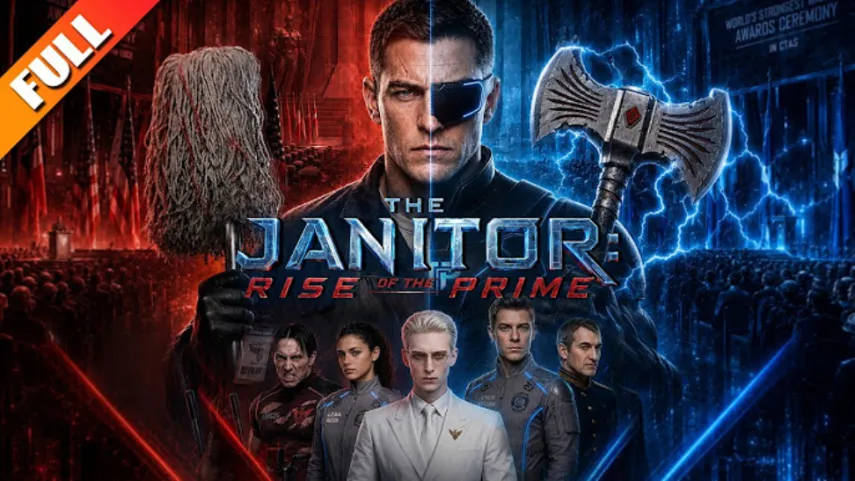
Ask what genre THE JANITOR: Rise of The Prime belongs to and you'll get a different answer depending on when you ask. Early on, it looks like a slow-burn revenge drama — a man in voluntary exile, scrubbing floors while the world around him mistakes humility for helplessness. By the midpoint it has evolved into something closer to a mythological confrontation between two opposing theories of human potential. And by the time the drama reaches its final act, you realize it was never really a story about fighting at all. It was always about what the Augmented empire — with all its predictive algorithms and synthetic soldiers — fundamentally cannot model: the interior life of a man who chose to be ordinary when he didn't have to.
THE JANITOR: Rise of The Prime runs 57 episodes on NetShort and earns every one of them.
What Episode 1 Feels Like: The Controlled Burn
The drama opens on a premise that demands patience from its audience, and rewards it immediately. Cole — the world's invincible Super Soldier — is mopping a floor. Not as a disguise in any active sense. As a commitment. His mother was murdered, and in her memory he sealed his power with a three-year promise: no combat, no disclosure, no return to the life that made him the most dangerous person alive. The early episodes sit inside that tension the way a coiled spring sits inside a mechanism — everything is still, but nothing is at rest.

What the drama understands about this setup is that the humiliation Cole absorbs from those around him isn't incidental. It's structural. Commissioner Holt and the soldiers around Cole treat him as a janitor with contempt; Marcus, a rival, establishes a hierarchical dynamic that Cole endures with complete calm while everyone else projects their anxieties onto him. Every slight is load-bearing. The audience is being shown, precisely and repeatedly, the gap between how Cole is perceived and what Cole actually is — and that gap is the drama's primary source of tension in its first third.

The archetype at work here is unmistakable: the Sleeping King, the warrior in dormancy, the hero who must be forced back into himself. Cole doesn't choose to re-emerge. He is pulled. And the trigger — his sister's life in danger — is the only force the drama correctly identifies as large enough to break a promise made to the dead.
What Shifts at the Midpoint: The Seal Breaks, and Everything Changes
Cole's transformation sequence — the lightning effects, the blue glow in his eyes — signals the shift from hidden potential to active force. But the drama is careful not to let the reveal become a simple power fantasy. When Cole shows 30% of his capacity in the arena and the assembled soldiers, including the veteran Phantom, are stunned into silence, the scene doesn't play as triumph. It plays as exposure — a man who wanted to stay hidden, now visible.

The Augmented empire enters the drama as its central antagonist structure, and the show does something genuinely interesting with their design. This isn't a villain powered by cruelty or ambition in the traditional sense. The Augmented's philosophy is that data can predict and therefore defeat anything — their warriors are synthetic, their strategies are algorithmic, and their confidence is rooted in the belief that human variables can be fully modeled. The villain in the white suit, who articulates a philosophy of "fragile spirit" with chilling certainty, isn't wrong that most humans are predictable. He's wrong about Cole.

This is where the drama's mythological scaffolding becomes most visible. Cole isn't simply stronger than the Augmented's warriors — he represents something their entire system was designed to eliminate: a human being forged by grief, restraint, and choice rather than optimization. When Cole states that the edge lives in the mind — that it's not about muscles or blood but willpower — it lands as the drama's philosophical thesis, not just a battle cry. The Augmented can mass-produce soldiers. They cannot manufacture a Cole.
Lena, Cole's sister, functions as the drama's moral compass and its structural accelerant — the character whose dramatic function is to pull Cole back into the world he abandoned. But the drama resists making her purely passive. Lena has her own mission to climb the ranks and find killers; her training-room scenes establish her as an agent with her own objectives, not simply a person waiting to be rescued. Her relationship with Cole is the drama's most textured — it carries the weight of a shared history that neither of them can fully articulate, which creates the kind of tension that action sequences alone can't generate.
What the Final Act Delivers: Data Versus the Unquantifiable
Without entering spoiler territory, the drama's final confrontation crystallizes its central argument with unusual clarity for the short drama format. The villain injects a glowing red serum and declares he will tear Cole apart — yet his reliance on simulation and statistics proves to be the exact limitation Cole exploits. The visual language here is deliberate: red energy versus blue, synthetic enhancement versus something the drama can only call will. It's binary, yes, but the binary is earned by the preceding fifty-odd episodes of careful characterization.
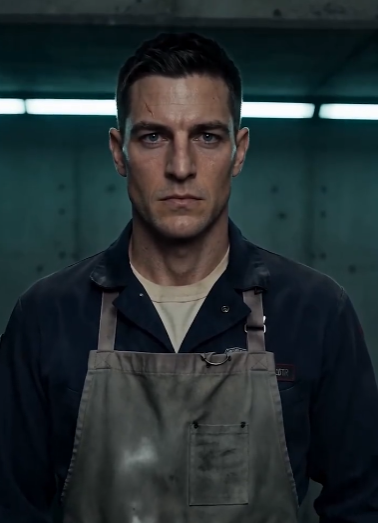
Viewer responses note that the line "you can't manufacture will" lands as a mic drop moment — and that assessment is accurate not because the line is particularly novel as writing, but because the drama has spent its entire runtime proving the claim before stating it. The philosophy arrives as confirmation, not exposition.
Who This Is For
THE JANITOR: Rise of The Prime will work best for viewers who enjoy the hidden-power genre but want the philosophical scaffolding to carry actual weight. If the drama's central question — can organic human will defeat a system engineered to predict and neutralize it — registers as interesting rather than rhetorical, you'll find 57 episodes of genuinely escalating answers. The show is tagged as Sci-Fi, Karma Payback, and Return of the King on its NetShort listing, and all three labels apply, though none of them individually captures the drama's real preoccupation, which is something closer to the philosophy of what makes a person impossible to model.

Where to Watch
Available at NetShort. THE JANITOR: Rise of The Prime is available to watch free on the NetShort app (iOS and Android) and via the NetShort website. Some episodes may require in-app access; the NetShort app is available for free download.


![[Dubbed Version]The Accidental Bride](https://v.melolo.com/b1265344voduse1318177724/f6e24ef75145403706111668422/DX2OtNAjMrgA.webp!15491.webp!15491.webp)
![[ENG DUB] Rise of the Resilient](https://v.melolo.com/b1265344voduse1318177724/2cbe04db5145403727621177053/bLIVDrRX6LsA.webp!15491.webp!15491.webp)