
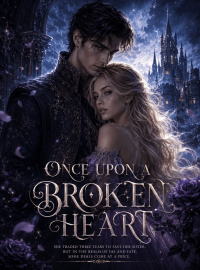
Once Upon a Broken Heart
Chapter 26
Chapter 26: Once Upon a Broken Heart
A year later.
The atlas was finished.
It had taken the full year, which she had expected—there was the northern survey to complete and incorporate, and the canal district commission, and three other projects she'd taken on as the shop's reputation had spread in directions she hadn't anticipated. Cassian had contributed seventeen corrections to pre-existing maps, each one sourced from personal geographic memory across three centuries, and each one had proven accurate when she'd verified them through separate survey. She'd added a notation system for Fate-proximate territories that was now being used by two other cartographers who'd learned of it through Soren's research.
The atlas her father had started, she had finished. It was larger than he'd intended—three volumes, the third entirely new territory—and it had both of their notations in it: his careful handwriting in the early sections, hers in the later ones, and in the third volume, occasional additions in a third hand, in the old language, rendered in ink she didn't use, marking places she hadn't been and couldn't have reached without navigation through the between-space.
The third volume's title page said:
Cartography of Aravel and Proximate Territories Vol. III: The Known and Adjacent Survey completed by I. Vane, with geographic consultation
She had wanted to put his name on it.
He had declined, on the grounds that the attribution of a Fate to a human document was complicated, historically, and also that the work was hers.
"The geographic consultation," she had said.
"Is consultation," he had said. "The map is yours."
"The map is accurate," she had said. "That's both of ours."
He'd looked at her with the expression that had replaced the managed neutrality—the one she'd first seen at the crossroads after the third tear, and which appeared regularly now, when she said something that articulated what he already knew but hadn't had words for.
They'd put with geographic consultation and left it at that.
The Court of Fates convened in December, for the year's accounting.
She attended now—not as a party to a compact, not as a witness to terms, but as what she'd become: a person who had mapped the between-space boundary and whose records were used by the Court as part of its territorial understanding. Fortune had a formal role for her that she'd invented and that Isla suspected existed primarily because Fortune enjoyed being right about things and this made her demonstrably, permanently right.
Love was at the back.
She found Love after the proceedings, as she often did.
"You've been busy," Love said.
"The third volume is finished."
"I know." Love's tired eyes were different today—still tired, still old, but with the quality she'd noticed more over the past year: the tiredness of a long race with the end in sight. "It'll be used for a long time."
"I hope so."
"Maps of the territories your father started and you finished," Love said. "That's a particular kind of complete act."
She thought about the vault. The classification system. The shelf with her father's surveys and the continuation beside them.
"Yes," she said.
Love looked at her with the comprehensive, entirely unhurried attention of a Fate whose domain was everything she was discussing.
"You know," Love said, "in three hundred years of watching his situation, I have occasionally wondered if I was wrong. Whether the grief of complete knowing could break the curse, or whether the curse was simply—what it was. Permanent." A pause. "I was not wrong."
"No," Isla agreed.
"He's different," Love said.
"Yes. He is." She paused. "Better, I think. But I'm biased."
"Mapmakers' daughters are not supposed to be biased," Love said.
"They note the bias in the margin," she said. "And they continue."
Love looked at her for a long moment. Then—something she hadn't seen from Love before: a smile. Brief, tired, entirely genuine.
"Your father would have approved," Love said.
She stood with this.
"Yes," she said. "I think he would have."
The shop at night.
She had finished the atlas. She was starting something new—a project she'd been thinking about for a year, since the northern survey: a series of maps of the between-spaces themselves. Not the Fate domains—she didn't have access to all of those. But the threshold points, the crossroads, the places where the mapped and unmapped worlds came closest. The places on the map that her father had marked here knowledge ends.
What was beyond them, carefully recorded.
What was on the other side of the edge.
He was reading in the chair across from the desk. He had been reading in that chair on and off for a year, in the way that people were in a place when they were in it, without ceremony or announcement. The shop had absorbed this the way it had absorbed other things: the particular quality of his attention, the care with which he handled the atlas volumes, the way the lamp seemed to behave slightly differently in his vicinity.
She looked at the new project's first page.
She looked at the empty space at the top where the territory she was mapping began.
She wrote, in her father's notation for the edge of the known:
Here knowledge ends.
She looked at it for a moment.
Then she wrote, below it:
Survey: ongoing.
"Title?" Cassian said, from across the room, without looking up from his book.
"The cartography of what we don't know yet," she said.
He looked up then. The expression—the one that had replaced everything else—was very clear in the lamplight.
"Volume one," he said.
"Volume one," she agreed.
She began.
There are stories that end with a kingdom. There are stories that end with a curse. This one ends with a map—unfinished, with a notation at the edge that reads: continue. And someone who will.
THE END
"The most important notation on any map is the one that marks where the knowledge runs out. Not because the not-knowing matters more than the knowing—but because it means the map is still alive. Still going somewhere. The world continues past the edge of every map ever made. That's not a failure of cartography. That's the whole point."
— Aldric Vane, Cartographer, from the foreword to his unfinished northern survey